
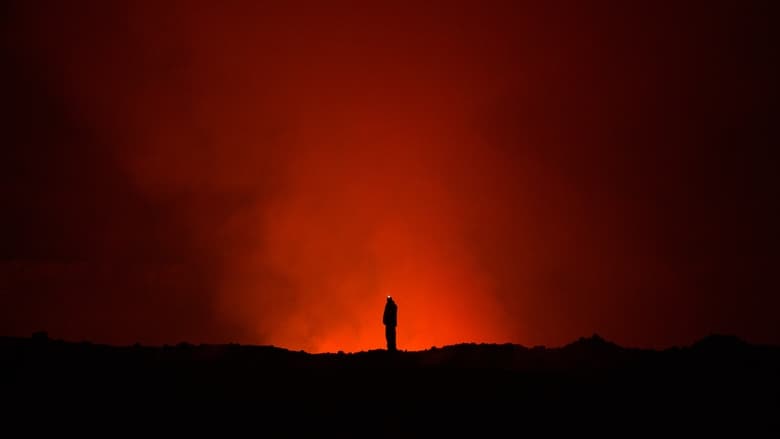
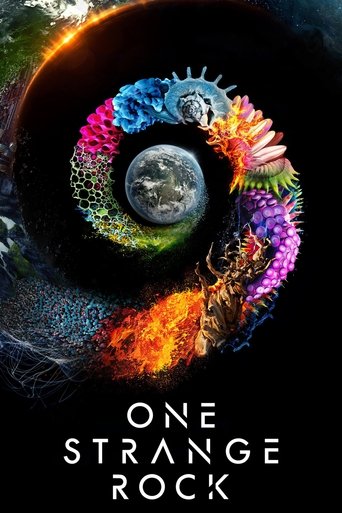
One Strange Rock
A mind-bending, thrilling journey exploring the fragility and wonder of planet Earth, one of the most peculiar, unique places in the entire universe, brought to life by the only people to have left it behind – the world’s most well known and leading astronauts.
Seasons
Episodes
Our perfectly calibrated, breathing planet. For those privileged few who have seen Earth from space, the very first thing they notice is the thin blue line of atmosphere that clings to our planet and sustains life. The story of how the Earth creates and regulates that oxygen is mind-blowing. From snowflakes in the arctic to plankton, desert sandstorms, and rivers in the sky; an incredible chain of connections reveal just how incredible our home is. Everything connects so life and planet breathe together.
A planet sculpted from cosmic violence. Earth is a very lucky planet. It has ended up the right size and in the right place. This only happened because of violent cosmic collisions. The crazy thing is, if things had been even slightly different, with more or less collisions, we wouldn't be here. We discover the moments that could have destroyed us, but instead made our planet what it is.
Earth protects itself from the sun. The David and Goliath story of Earth's relationship with its greatest threat, our seemingly benign Sun. The Sun is the big violent boss of the Solar System, throwing out devastating particles and energy. Without several shields, one generated by our unique planetary core, another by our atmosphere, and a third by our interconnected weather systems… life on Earth would never have survived.
Earth gives birth to life. The building blocks of life are common across the universe, but life is rare. What's so special about Earth that it emerged here? Only here on Earth have we found the elixir of life; water in its three forms. But for life to emerge this isn't enough… huge tides created by the proximity of our perfect Moon, plate tectonics, volcanoes and lightning mean the Earth is a dynamic planet. It's a huge planetary chemical experiment, a bubbling cauldron that transforms dead minerals into deoxyribonucleic acid (DNA); the code for all life.
Earth, the great killer. Without the cycle of death and sacrifice, from cellular to planetary, life would not be here. From the deaths of stars, to planetary scale mass extinctions and the sacrifice of individuals for a greater genetic good, this is the story of how life evolved hand in hand with death. Death drives evolution. It's hardwired: from our cells to our landscapes, our colorful living planet is only possible because of it. Death leads to opportunity and biodiversity which ironically ensures life on the planet is never wiped out. It's not enough for our planet to be habitable… it also has to be lethal.
We are all planets. Is it possible for intelligent life to escape destruction, either from the planet or ourselves? Or are we destined for extinction like 99% of all species before us? Our best chance of survival may be to escape earth and build another colony somewhere else. But there are real barriers: space radiation, microgravity and the bacteria inside us will conspire against us. And our DNA is coded for the conditions here on earth, so if we ever manage to colonize another planet those who are born there will evolve into another species.
Earth's great paradox. For our planet to become inhabitable for life, you already need life. Ever since life emerged, microbes, plants and animals have all sculpted the planet's surface and air in the strangest of ways; fish poop creates islands; dead animals create mountains; lichen drive continents. But life also has the power to destroy our world. We are changing the climate, but we are not the first to do so. Long before us, microbes froze the planet and almost wiped out all life. The difference between us and them is we are conscious of our actions.
The freak accident behind complex life. All life on earth started as single cell bacteria and stayed like that for 2 billion years. Successfully spreading across the planet. So even if we do find alien life, what are the chances of that life being complex – like us? Vanishingly rare… on our strange rock, it's all down to a freak event, which accidentally happened when one cell ate another to create a kind of cellular power pack: mitochondria. This almost miraculous event transforms earth into a complex interconnected food web based on a competition for food. And at the top of the pyramid sits us humans.
Your brain is an anomaly. We tend to think that once the first life emerged it was inevitable that it would eventually evolve into us. But there is nothing inevitable about consciousness. For over 2 billion years no life on earth possessed a brain. And even today, 90% of life doesn’t have a brain. How life and our strange rock came together to create consciousness is a story of almost impossible and unnecessary coincidences….
There's no place like home. We wrap up the series with the story of NASA's most experienced female astronaut, Peggy Whitson, as she returns home to earth. We might possibly be the only intelligent life in the universe. Life is rare, complex life rarer, and intelligent life may be an evolutionary bad idea or dead end that is rarer still… and that means that it's possible that we humans may be the only thing in this huge and amazing universe that can appreciate its strangeness with awe and wonder.
More Like This
TV shows with a similar genre, style and mood

Warriors of Liberty City

We Speak Dance

The Radical Story of Patty Hearst
Hollywood Love Story
Mafia Killers With Colin McLaren
The 90s Greatest
Cults and Extreme Belief

Unspeakable Crime: The Killing of Jessica Chambers

WWE Untold

Salt Fat Acid Heat

No Passport Required
Swamp Mysteries with Troy Landry
FILMARNIK does not host any video files. All content is provided by third-party sources.